

Adorable robots, Gemini table tennis, & more | 🤖 🚨Robotics Digest Weekly

Expressive humanoids meet adaptive grippers. Digital twins enter Unity. Human augmentation meets space assistance. The machine coordination layer writes itself across every environment where humans operate.
Let’s dive into the latest developments shaping the future of robotics 👇
Unitree's R1 humanoid launches at $5900 with 26 degrees of freedom. Weighing 25kg, the system integrates multimodal AI for voice and vision processing, with customization frameworks for specific applications. Unitree demonstrates that capable humanoid hardware no longer requires institutional budgets. X (formerly Twitter)
UK's Humanoid validates dual 7-DOF arms for HMND 01 integration. The robotic arms matched simulation performance in real-world testing, passing mechanical and assembly validation checks. Humanoid's approach suggests that modular, validated subsystems accelerate full-stack humanoid development. X (formerly Twitter)
Pollen Robotics releases Unity package for Reachy 2's digital twin. The AR/VR environment offers full robot control through the Reachy 2 stack, targeting robotics education and human-robot interaction research. Digital twins become the bridge between simulation and physical deployment. X (formerly Twitter)
RobotEra's L7 humanoid delivers 55 DoF and 400 Nm torque capacity. The system lifts 44lbs with dual arms and achieves 9mph sprint speeds, coordinated through integrated body-brain control architecture. RobotEra shows that power and precision can coexist in humanoid form factors. X (formerly Twitter)
DeepMind trains robot AI through table tennis for real-world complexity. Google's research uses the sport's demands—reaction time, precision, strategy—as a testbed for adaptive machine behavior. Table tennis becomes a lens for understanding how machines navigate unpredictable environments. Interesting Engineering
Fourier previews GR-3 humanoid with expressive, care-focused design. The rendered sneak peek positions the system for caretaking and human interaction applications, emphasizing softer aesthetics over industrial functionality. Fourier's approach suggests that humanoid acceptance depends as much on emotional design as technical capability. Interesting Engineering
Meta's neuromotor interface captures muscle signals for device control, published in Nature. The band-based system reads electrical activity from hand and finger movements, translating intent into machine commands. Meta Reality Labs proves that the gap between human intention and machine response continues to collapse.
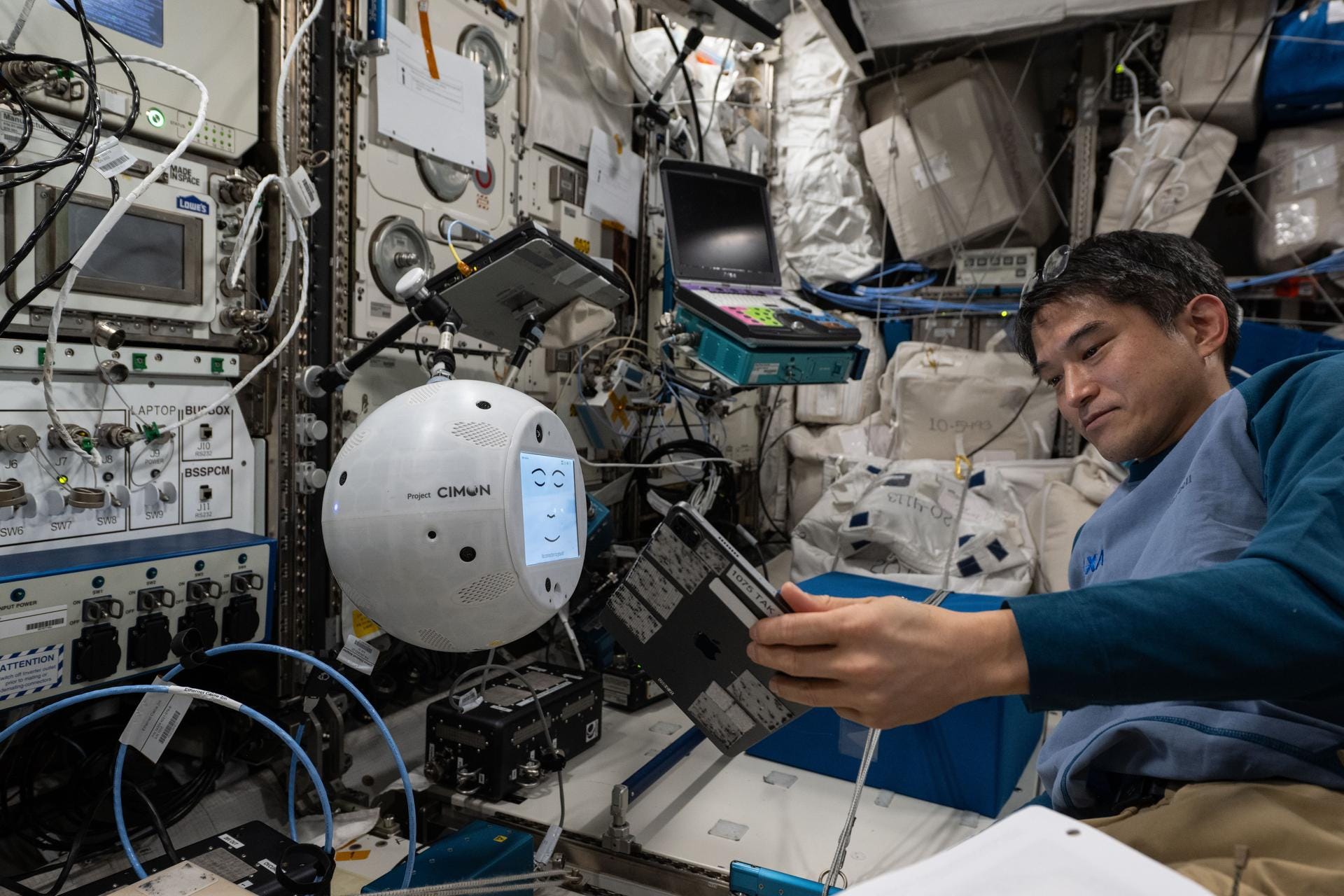
CIMON, the AI assistant, operates in microgravity aboard the International Space Station. The spherical robot uses voice commands and autonomous navigation to provide hands-free access to procedures, documentation, and mobile recording capabilities. Airbus, IBM, and DLR demonstrate that machine assistance adapts to humanity's most extreme operational environments.
Virginia Tech develops switchable adhesive grippers for assistive robotics applications. The soft-rigid hybrid system uses deflatable fingertips that create adhesive bonds on contact, enabling manipulation of objects from sand grains to water jugs through joystick control. Losey and Bartlett's research demonstrates that adaptive gripping solves the texture-size spectrum problem in human-assistive manipulation tasks.
PSYONIC demonstrates bionic hands at Comic-Con through Doc Ock cosplay integration. The San Diego startup develops prosthetic systems for both human amputees and robotic platforms, showcasing dual-market applications through theatrical demonstration. PSYONIC's approach suggests that shared hardware development between human augmentation and robotics accelerates capability advancement across both domains.
Hardware costs collapse while capability density increases. The standardization layer emerges through validated modules and shared coordination protocols. We're watching the Android moment for robotics unfold in real time.
Thank you again for joining us this week.
Follow @openmind_agi to stay informed on the real-time evolution of AI-powered robots that we're helping to power.